Phone:
(+971) 56 921 3754
Physical address:
Office #201, Al Quoz Industrial Area
Dubai, United Arab Emirates.

Diesel Generator Rental in UAE: Prime, Standby & Continuous Power
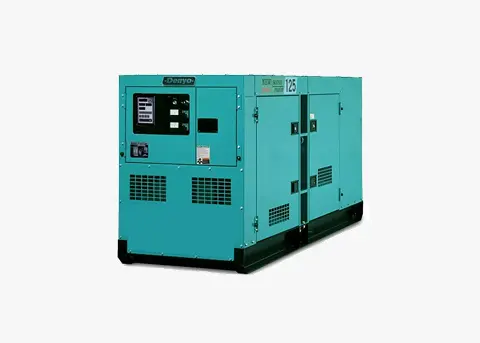
Rental Generator supplies heavy-duty diesel generator rental across the UAE — 20 kVA to 2,000 kVA, Cummins, Perkins and Volvo Penta powered, prime and standby rated — for construction, industrial, oilfield-adjacent and commercial sites across Dubai, Abu Dhabi and Sharjah. Call it in and we dispatch within 2 hours; no generic desk quote, a site-sized machine with the cabling and ATS panel to match.
Why Choose Our Diesel Fleet?
Most rental quotes in this market are a kVA number and a day rate, nothing else. What’s missing is the part that actually determines whether your site runs clean for six months or you’re calling a breakdown line at 3am: how the set was spec’d, who services it, and whether the cabling was sized for your actual load or just whatever was in the yard.
Our fleet is UAE-tropicalised from the factory, not retrofitted after a unit that struggles here arrived from a cooler market. Every generator is serviced on a fixed hours-based schedule by our own technicians — not a third-party subcontractor we hope shows up — and every quote includes the accessories that actually get it running: cabling, ATS panel, bunded tank. We size against your real connected and starting load, not the number that’s easiest to quote.
At a glance:
- 20 kVA to 2,000 kVA, Cummins / Perkins / Volvo Penta, prime and standby rated
- Rated for continuous 50°C ambient operation with no output derating in the summer months
- Class H alternator insulation, IP23 enclosures as standard
- Full turnkey package: bunded tank, cabling, ATS/AMF panel, technician commissioning
- 2-hour emergency dispatch target across Dubai, Abu Dhabi and Sharjah
- In-house servicing — not outsourced to whoever’s available
Fuel Burn Dynamics: Why Load Factor Is the Number That Actually Costs You Money
This is the section almost none of your competitors write — and it’s the one that actually closes deals, because fuel is the single largest line item over the life of a rental, bigger than the hire rate itself.
A diesel engine’s specific fuel oil consumption (SFOC) — grams of fuel burned per kWh delivered — is not flat across the load range. Below roughly 50% load, fixed parasitic losses (oil pump, water pump, internal friction) stay constant while useful output drops, so the fuel cost per kWh delivered climbs sharply. Above 75% load, the curve goes almost flat — you’re close to the engine’s efficiency sweet spot. This is why a generator quoted and sized for “worst case” peak load but run at 30–40% average load burns far more fuel per unit of work than one correctly sized to run at 70–85%.
Indicative fuel burn — 500 kVA (400 kW) set, prime rating:
Load | SFOC (g/kWh) | Fuel Burn (L/hr) | Fuel per kWh delivered |
|---|---|---|---|
25% (100 kW) | ~300 | ~35 L/hr | Worst efficiency — avoid sustained running here |
50% (200 kW) | ~235 | ~55 L/hr | Acceptable, not optimal |
75% (300 kW) | ~215 | ~76 L/hr | Sweet spot — best fuel economy |
100% (400 kW) | ~210 | ~99 L/hr | Full rated output, marginal efficiency gain over 75% |
Actual figures vary by engine model and site conditions — confirm against the specific unit’s datasheet. The pattern holds across the fleet: oversizing a generator “to be safe” and then running it at 25–30% load is one of the most common and most expensive mistakes on UAE sites.
We size against your actual expected load profile, not just your peak demand figure — and we’ll tell you directly if a smaller unit run closer to 75% load will cost you less over the hire period than a bigger one run at a third of its capacity.
Built to Meet UAE Regulations & Site Standards
A generator that fails inspection after it’s already installed and cabled is a schedule disaster, not a minor fix. This is the part most rental outfits leave you to discover on your own.
Utility & electrical compliance — installations must comply with DEWA regulations in Dubai, with equivalent requirements under ADDC in Abu Dhabi and SEWA in Sharjah: correct earthing, anti-islanding protection so the set can’t back-feed the grid, and exhaust routing that meets air-quality requirements.
Civil Defence & fire safety — fuel storage and generator installations fall under UAE Civil Defence fire and life-safety codes. Bunded fuel tanks, correct clearance from structures and access routes, and compliant exhaust/ventilation paths aren’t optional extras — they’re what gets your installation signed off instead of flagged.
Noise ordinances — Dubai Municipality caps residential-area generator noise at 65 dBA at the property line, with daytime construction capped at 55 dBA (7am–8pm) and night-time limits down to 45 dBA. Abu Dhabi’s Environment Agency (EAD) actively maps noise across the emirate and flags repeat-offender sites.
Oilfield & industrial-spec sites — for ADNOC-adjacent and industrial plant work, expect additional requirements around spark arrestors, explosion-proof fittings in classified zones, and documented load-bank testing before handover. Tell us the site classification up front and we’ll confirm the unit meets it before it leaves the yard — not after it’s rejected at the gate.
We hand over test certificates and compliance documentation with every delivery so your HSE and MEP consultants have what they need for sign-off, not a generator and a shrug.
Ideal Applications in Dubai & Abu Dhabi
- Civil construction & infrastructure — tower cranes, batching plants, dewatering pumps and site offices on projects across Al Quoz, Jebel Ali, Dubai South and Mussafah; prime-rated sets sized for the real starting-current surge of motor loads, not just running load
- Industrial plant & manufacturing — continuous and standby power for production lines and process plant in ICAD (Industrial City of Abu Dhabi) and Dubai Industrial City, where an unplanned stoppage costs more than the generator itself
- Oil, gas & energy-adjacent sites — rugged, classified-zone-capable sets for support operations around ADNOC project areas and remote industrial locations
- District cooling & utilities — standby and bridging power for plant rooms during planned maintenance or capacity upgrades
- Marine & port operations — shore power and temporary supply for vessels, dry docks and port-side equipment
- Events, exhibitions & government contracts — short-term prime power for exhibitions, public infrastructure works and government-tendered projects requiring documented compliance
Tell us the site and the load, and we’ll tell you the rating — not just hand over whatever’s parked closest to your postcode.
Available Fleet Capacities
Capacity (kVA) | Typical Use | Fuel / Spec | Runtime @ 75% Load | Quick Link |
|---|---|---|---|---|
20–50 kVA | Site offices, small retail, cabins | Skid or trailer, Perkins | ~20–24 hrs on tank | View |
100–150 kVA | Mid-size construction, hotels | Skid, Cummins/Perkins | ~24–26 hrs on tank | View |
250–350 kVA | Large sites, commercial towers | Skid, Cummins, Class H insulation | ~28–30 hrs on tank | View |
500–750 kVA | Industrial plant, hospitals | Skid, synchronisation-ready | ~30–33 hrs on tank | View |
1000–1500 kVA | Base-load industrial, large events | Containerised, parallel-capable | ~33–36 hrs on tank | View |
2000 kVA | Data centres, heavy industrial | Containerised, multi-unit sync | ~36+ hrs on tank | View |
Every capacity listed ships as a complete turnkey package, not a bare generator: bunded fuel tank (up to 120% spill-contained capacity), forklift pockets and lifting eyes for fast crane or forklift positioning on tight urban sites, and IP23-rated control panels built for coastal humidity and desert dust. Need a configuration outside this table — 20 kVA portable up to multi-MW parallel container banks? Tell us the load and we’ll confirm availability.
Prime vs. Standby vs. Continuous — Which Rating Do You Need?
This is the question that separates a correctly budgeted project from an engine rebuild halfway through the contract, and it’s the one procurement teams most often skip because the day-rate difference looks small up front.
- Standby rating — maximum output during a mains outage, variable load, a limited number of hours per year. Correct for grid-connected sites where the generator is a safety net, not the main supply. Running a standby-rated set as your primary power source accelerates wear on components not built for continuous thermal cycling.
- Prime rating — unlimited running hours at variable load. Correct for construction sites, remote operations, and any site where the generator is the power source. A prime-rated set at a given kVA figure is physically a larger, more robustly built machine than a standby-rated set quoted at the same number.
- Continuous rating — unlimited hours at a fixed, constant load. Correct for base-load industrial operations with steady, predictable demand.
The cost of getting it wrong: a standby-rated engine run as prime power doesn’t fail immediately — it fails six to ten weeks into a twelve-week contract, usually during your highest-demand period, because the thermal cycling and duty profile it was never built for catches up with it. The replacement unit, the project delay, and the argument over whose spec sheet was wrong cost far more than the small premium a correctly rated set would have added to the original quote. Tell us your actual duty cycle — not just a kVA target — and we’ll quote the rating that protects your schedule, not just the lowest number on the page.
Built for 50°C: Why UAE Ambient Conditions Matter
A generator’s nameplate rating is tested at 25°C ambient, standard atmospheric pressure, per ISO 3046/8528. Put the same machine into a Dubai or Al Ain summer and two things work against it at once: hotter intake air is less dense, so the engine gets less oxygen per combustion cycle for the same displacement, and the cooling system has a smaller temperature differential to reject heat into — the radiator is trying to dump heat into air that’s already close to the engine’s own operating temperature. The result is derating: the set simply cannot sustain its nameplate output without the alternator and engine running into their own thermal limits.
This is exactly the condition a standard European-spec canopy, designed around a 40°C ceiling, runs into every August — right when your site’s AC and cooling load (and therefore total demand) is also at its annual peak.
Every unit in our fleet is specified against UAE ambient conditions, not a cooler reference market:
- Oversized radiator and cooling matrix sized for continuous 50°C ambient operation with no output derating within the unit’s rated capacity
- Class H alternator insulation (NEMA MG1) — the higher temperature-rise tolerance that keeps the alternator windings within safe limits when ambient heat alone eats into the thermal margin a standard-spec unit would need
- IP23-rated control panels and corrosion-resistant finishing for coastal humidity and desert dust, not a retrofit kit bolted onto an imported unit
If a competitor’s datasheet doesn’t state an ambient temperature rating, ask for it directly — it’s the difference between a generator that holds its rated kVA in August and one that quietly falls short exactly when your load, and your patience, are at their peak.
Features That Set Our Fleet Apart
ATS/AMF panels — Automatic Transfer Switch / Auto Mains Failure control brings backup power online within seconds of a mains outage, no manual switching, no one standing by the generator waiting to start it.
DSE synchronisation controllers — for multi-unit deployments, our sync panels (Deep Sea Electronics-class controllers) handle load-sharing across parallel sets using droop control, so load splits proportionally between units without needing active communication between them — and if one set trips, the others pick up the load automatically rather than the whole site going dark.
Bunded fuel tanks — every unit ships with a spill-contained base (up to 120% capacity), protecting the site from fuel and oil leaks and keeping you clear of UAE environmental and fire-safety requirements.
Remote telemetry — fuel-level sensors and performance alerts flagged to our operations team before a developing issue becomes a site power failure, not after.
Class H alternator insulation, IP23 enclosures — the thermal and ingress protection margin that standard-spec imports don’t carry as standard.
Forklift pockets & lifting eyes — fast, low-disruption positioning on tight urban sites where a crane lift window is measured in minutes, not hours.
Load-bank testing on request — documented proof the set holds its rated output under full load before it’s signed off on your site, not just on a factory datasheet.
Frequently Asked Questions
Yes, significantly. A motor's starting current can be 4–6x its running current, and if the generator can't supply that surge, voltage sags enough to trip protection or stall the start entirely. We size against your highest simultaneous starting load, not just the sum of running loads — send us your equipment list and starting method (DOL, star-delta, soft-start) and we'll confirm the correct kVA.
It will run — for a while. The engine and alternator weren't built for sustained thermal cycling at that duty, so you'll see accelerated wear, shortened service intervals, and a real risk of failure mid-contract, usually at your worst possible moment. The fuel and rental savings up front rarely cover the cost of the breakdown and schedule delay later.
Yes, on request — we can load-bank test a unit to its rated output before it leaves the yard or on-site after installation, with a test certificate for your HSE or MEP consultant's records.
Yes — our synchronisation panels handle load-sharing across multiple units using droop control, so load splits automatically between sets and the system keeps running if one unit needs to come offline for service.
Tank size is matched to your expected runtime between refuelling visits — typically 24–36 hours at 75% load depending on capacity. Fuel is included in the rental and topped up on a scheduled visit cycle, not left for you to manage.
Our target is dispatch within 2 hours across Dubai, Abu Dhabi, Sharjah and the Northern Emirates for genuine emergency call-outs — response time depends on your location and current fleet availability, and we'll tell you honestly if a specific site falls outside that window rather than promise something we can't hold to.
Yes — every unit is specified for continuous operation up to 50°C ambient without output derating, unlike standard European-spec imports built for cooler climates.
Need a Diesel Generator for Rent in UAE?
Speak with our power engineers for instant availability, fast turnkey pricing, and same-day delivery across the UAE.