Phone:
(+971) 56 921 3754
Physical address:
Office #201, Al Quoz Industrial Area
Dubai, United Arab Emirates.
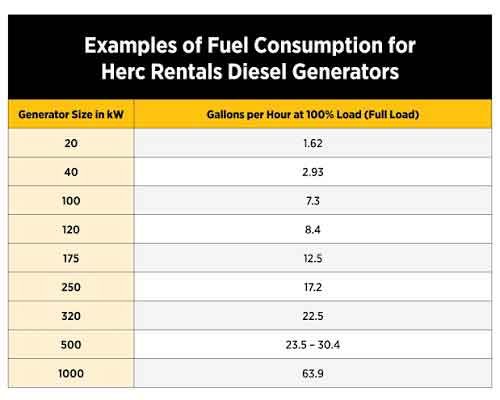
Diesel Generator Fuel Consumption Chart (50 kVA to 2000 kVA):
A diesel generator fuel consumption chart l/hr helps businesses estimate how many litres of diesel a generator needs per hour at different electrical loads. For construction sites, factories, commercial buildings, data centres and etmporary power projects in the UAE, this information is essential for fuel budgeting, tank sizing and planning reliable power supply.
Fuel consumption depends on the generator’s kVA rating, engine model, operating load, ambient temperature and maintenance condition. Manufacturer specifications are the preferred source for exact figures. For preliminary planning, published fuel-consumption charts provide useful estimates across common generator sizes.
This guide covers generator fuel burn rates at 50%, 75% and 100% load, how much diesel a 500 kVA generator uses, the risks of prolonged low-load operation, bulk fuel storage and the effect of UAE summer heat on fuel management.
Diesel Generator Fuel Consumption Chart L/hr by kVA
The following table uses a published indicative consumption model based on a power factor of 0.8 and approximately 0.27 litres per kWh at full load. Values for 50–1,500 kVA follow that model, while the 2,000 kVA figures are extrapolated for preliminary planning. These are not guaranteed figures for every engine or generator set.
| Generator capacity | Approx. output at PF 0.8 | 50% load (L/hr) | 75% load (L/hr) | 100% load (L/hr) |
|---|---|---|---|---|
| 50 kVA | 40 kW | 5.4 | 7.9 | 10.8 |
| 100 kVA | 80 kW | 10.8 | 15.8 | 21.6 |
| 150 kVA | 120 kW | 16.2 | 23.7 | 32.4 |
| 250 kVA | 200 kW | 27.0 | 39.4 | 54.0 |
| 350 kVA | 280 kW | 37.8 | 55.2 | 75.6 |
| 500 kVA | 400 kW | 54.0 | 78.8 | 108.0 |
| 800 kVA | 640 kW | 86.4 | 126.2 | 172.8 |
| 1,000 kVA | 800 kW | 108.0 | 157.7 | 216.0 |
| 1,500 kVA | 1,200 kW | 162.0 | 236.5 | 324.0 |
| 2,000 kVA | 1,600 kW | 216.0 | 315.4 | 432.0 |
Important: This is a generalized estimating model, not a manufacturer-certified fuel chart. Actual figures can vary materially with the engine, prime or standby rating, alternator, ambient conditions and fuel specification. Confirm all values with the selected generator’s official datasheet before procurement or rental budgeting.
How to read the fuel burn table
The percentage refers to the electrical load relative to the generator’s applicable rated output, not the percentage of fuel remaining in the tank.
For example, a 500 kVA generator at a power factor of 0.8 has a nominal real-power output of 400 kW. At 75% load, it supplies approximately 300 kW. Under the illustrative model, fuel consumption is about 78.8 litres per hour.
Actual engine fuel consumption does not increase in a perfectly linear relationship with electrical load. The figures above are therefore useful for initial comparisons, but the exact manufacturer’s fuel curve should determine the final estimate.
How Much Diesel Does a 500 kVA Generator Use?
The answer depends on the engine and actual electrical demand. Under the illustrative fuel-consumption model above, a 500 kVA generator uses approximately 54 litres per hour at 50% load, 78.8 litres per hour at 75% load and 108 litres per hour at full load.
However, manufacturer data shows why one generic number cannot be applied to every 500 kVA set. Cummins offers multiple generator models in this capacity range, including the C500D5P with a KTAA19-G10 engine. Different engine configurations can have different fuel-consumption figures.
500 kVA generator: estimated fuel requirement
Using the illustrative chart values, assuming constant load
50% load
54 L/hr
1,296 litres/day
75% load
78.8 L/hr
1,891.2 litres/day
100% load
108 L/hr
2,592 litres/day
These daily totals assume 24 hours of uninterrupted operation at the same load. They are not guaranteed consumption figures for a particular generator.
For projects requiring this capacity, review the specifications of a 500 kVA generator before estimating diesel requirements. Confirm whether the quoted rating is prime or standby and obtain the manufacturer’s fuel figures at the expected load.
Generator Fuel Burn Rate UAE: Calculating Daily and Monthly Requirements
The generator fuel burn rate UAE businesses need for budgeting should reflect actual operating hours, load variations and site conditions. A construction project that operates for 10 hours daily will have a different fuel requirement from a facility running continuously for 24 hours.
The basic formula is:
\[ \text{Fuel required (L)}=\text{L/hr}\times\text{operating hours} \]
For example, consider a generator consuming an estimated 78.8 L/hr at 75% load.
| Operating period | Estimated diesel requirement |
|---|---|
| 1 hour | 78.8 litres |
| 8 hours | 630.4 litres |
| 12 hours | 945.6 litres |
| 24 hours | 1,891.2 litres |
| 30 days at 24 hours/day | 56,736 litres |
These calculations help determine fuel delivery frequency, storage requirements and operating budgets. For a real site, use an hourly load profile rather than assuming the generator remains at 75% load throughout the month.
Estimate fuel costs
Once the expected consumption and delivered diesel price are known, fuel costs can be calculated without relying on a fixed price assumption.
For example, if a generator consumes 630.4 litres during an eight-hour shift and the delivered diesel price is \(P\) per litre:
\[ \text{Daily fuel cost}=630.4\times P \]
Include delivery charges and any applicable service costs separately. This gives project managers a more realistic picture of operating expenditure.
Why Running a Diesel Generator at 25% Load Can Be Costly
Running a generator at 25% load may appear economical because it consumes fewer litres per hour. However, low hourly consumption does not necessarily mean efficient fuel use per unit of electricity generated.
Diesel engines have operating requirements that must be considered alongside fuel savings. Caterpillar identifies prolonged operation below approximately 30% of rated output as a potential cause of wet stacking in applicable generator sets.
What is wet stacking?
Wet stacking occurs when unburned fuel, carbon particles and oily deposits accumulate in the exhaust system during prolonged low-load operation. The condition may appear as dark, oily residue around exhaust joints or other exhaust components.
Possible consequences include:
-
Carbon and oily deposits in the exhaust system.
-
Excessive exhaust smoke and residue.
-
Accelerated wear associated with prolonged underloading.
-
Additional inspection, maintenance and potential downtime.
Wet stacking is not inevitable at every low-load operating point, and its risk depends on engine design, temperature, duration and operating conditions. Nevertheless, prolonged operation at very light loads should not be treated as a harmless way to save diesel.
How to manage generator underloading
The best approach is to select generator capacity that matches the site’s actual power demand, while allowing sufficient capacity for starting currents and peak loads.
Where appropriate, operators can consider staged generator operation, rotating units, or using multiple generators in parallel. A correctly designed load bank can also help qualified technicians test a generator under controlled loads.
Do not apply a universal minimum-load rule to every engine. Follow the specific manufacturer’s operating instructions, including any requirements for loaded operation or maintenance procedures.
External Bulk Fuel Tanks and Scheduled Tanker Deliveries
For long-running projects, the generator’s built-in fuel tank may not provide enough autonomy. External bulk tanks can support larger fuel requirements and reduce the frequency of manual refuelling.
Depending on site demand, a project may consider tank capacities ranging from 1,000 litres to 20,000 litres. These are planning options, not a claim that every tank size is suitable or approved for every site.
| External tank capacity | Illustrative use |
|---|---|
| 1,000 litres | Smaller generators or limited-duration operation |
| 2,000–5,000 litres | Medium-sized equipment and shorter delivery intervals |
| 10,000 litres | Higher fuel demand and longer operating periods |
| 15,000–20,000 litres | Large projects requiring substantial on-site fuel reserves |
Actual suitability depends on fuel consumption, permitted storage capacity, usable tank volume, delivery access and site safety requirements.
How to plan on-site fuel delivery
A scheduled tanker service can help prevent interruptions when generators run around the clock. The delivery schedule should be based on measured consumption and the minimum reserve required for safe operation.
For example, if a generator consumes 78.8 litres per hour, a nominal 5,000-litre tank represents approximately 63.5 hours of theoretical supply at that constant load. Usable operating time will be lower if some fuel must remain in reserve or cannot be drawn from the tank.
Good fuel-management practices include:
-
Monitoring tank levels and recording daily consumption.
-
Scheduling deliveries before the minimum operating reserve is reached.
-
Confirming tanker access, delivery windows and safe unloading arrangements.
-
Using suitable tanks, compatible fuel lines, spill containment and appropriate fire protection.
-
Checking fuel for water contamination and following the equipment manufacturer’s storage guidance.
In the UAE, petroleum-product storage and transport must comply with the applicable requirements of the relevant emirate and competent authorities. Abu Dhabi’s Department of Energy publishes petroleum safety and permit guidance, while Dubai has specific rules governing petroleum-product activities and transport.
How UAE Summer Heat Affects Diesel Fuel and Generator Efficiency
High ambient temperatures are a major consideration for generator operations in the UAE, particularly when equipment operates outdoors during summer.
The effect of heat should be understood in two separate ways: the physical properties of diesel fuel and the generator engine’s ability to deliver its rated output.
Diesel density and temperature
Diesel expands as its temperature increases. As a result, a litre of hot diesel contains slightly less mass than a litre of the same fuel at a lower temperature. This is a physical property of the fuel, not proof that the engine suddenly burns a particular percentage more diesel.
ISO 91 provides standard methods for correcting petroleum-product volumes measured at different temperatures to reference conditions.
At around 50°C ambient temperature, the actual fuel temperature depends on tank location, exposure to sunlight, fuel circulation and operating conditions. Therefore, the change in density and delivered volume should be measured or calculated using appropriate fuel data rather than assuming a universal percentage loss.
Engine performance in extreme heat
High ambient temperatures also affect the air entering the engine and the cooling system’s ability to remove heat. Depending on the generator design and its cooling package, high temperatures can reduce available output or require derating.
This matters because a generator may need to work harder relative to its available capacity to support the same site demand. Its actual fuel consumption should be assessed using the manufacturer’s performance and derating information for the expected operating conditions.
For reliable summer operation:
-
Select a generator with a cooling package suitable for the site’s design ambient temperature.
-
Maintain clear airflow around the radiator and ventilation openings.
-
Keep radiators, air filters and cooling systems properly maintained.
-
Protect external fuel tanks from unnecessary direct solar heating, while maintaining required ventilation and access.
-
Monitor engine temperature, load, fuel consumption and warning alarms.
-
Verify the manufacturer’s ambient-temperature derating requirements before finalising capacity.
A generator specified for a standard ambient temperature should not automatically be assumed to deliver its full rated output at 50°C. Confirm the actual rating and cooling performance for the intended site.
Choosing Heavy-Duty Diesel Generator Hire for UAE Projects
Fuel planning should form part of the generator selection process, not an afterthought. Construction sites, industrial facilities, commercial buildings and temporary power projects all have different demand profiles, operating hours and fuel-delivery requirements.
Before arranging heavy-duty diesel generator hire, establish the following:
-
The total running load and largest motor-starting requirements.
-
The required prime or standby generator rating.
-
Expected daily operating hours and load variations.
-
The manufacturer’s fuel consumption at the planned operating points.
-
Required fuel autonomy, external tank capacity and delivery schedule.
-
Cooling and derating requirements for the site’s maximum ambient temperature.
For larger installations, multiple generators may be appropriate where load variation, redundancy and continuity requirements justify them. The decision should be based on a properly assessed load profile and the manufacturer’s operating guidance.
Frequently Asked Questions
How much diesel does a 500 kVA generator use per hour?
An illustrative model estimates approximately 54 L/hr at 50% load, 78.8 L/hr at 75% load and 108 L/hr at full load. These values are useful for initial budgeting but may differ from the exact generator’s published specifications.
How do I calculate diesel generator fuel consumption in L/hr?
Divide the quantity of diesel consumed by the number of operating hours. If a generator consumes 240 litres over 10 hours, its average fuel consumption is 24 L/hr.
Is running a generator at 25% load bad?
Prolonged operation at very light loads can contribute to wet stacking and other operating problems in some diesel engines. Follow the manufacturer’s minimum-load guidance and avoid extended underloading where possible.
What size external fuel tank is suitable for a diesel generator?
Tank size depends on hourly consumption, required autonomy, usable tank volume, delivery frequency and applicable storage requirements. A 1,000-litre tank may suit some smaller applications, while large continuous-power installations may require significantly greater storage.
Does 50°C heat increase diesel generator fuel consumption?
High temperatures affect diesel density and can affect engine performance and available output. The actual change in litres per hour depends on the fuel temperature, engine design, load and derating conditions. Use manufacturer data and appropriate fuel-temperature corrections rather than applying a fixed heat penalty.
How can businesses reduce generator fuel costs in the UAE?
Accurate generator sizing, regular maintenance, load monitoring, reliable fuel-quality control and planned tanker deliveries can improve fuel management. For prolonged operation, selecting equipment that matches the site’s normal demand is particularly important.
Final Recommendations
A diesel generator fuel consumption chart is a starting point for estimating hourly, daily and monthly diesel requirements. For accurate project budgeting, combine indicative fuel burn rates with the specific generator’s manufacturer data, actual operating loads and site conditions.
In the UAE, summer heat, prolonged operating hours, external fuel storage and delivery logistics should all be considered when planning temporary or continuous power. A properly sized generator, a suitable cooling package and a well-managed fuel supply help support dependable operation while keeping running costs under control.
Need Reliable Temporary Power or Cooling in the UAE?
From 20 kVA mobile silent generators up to multi-megawatt synchronized power plants and 500 TR packaged chillers. Complete turnkey delivery, cabling, and 24/7 on-site maintenance across Dubai, Abu Dhabi, and Sharjah.