Phone:
(+971) 56 921 3754
Physical address:
Office #201, Al Quoz Industrial Area
Dubai, United Arab Emirates.
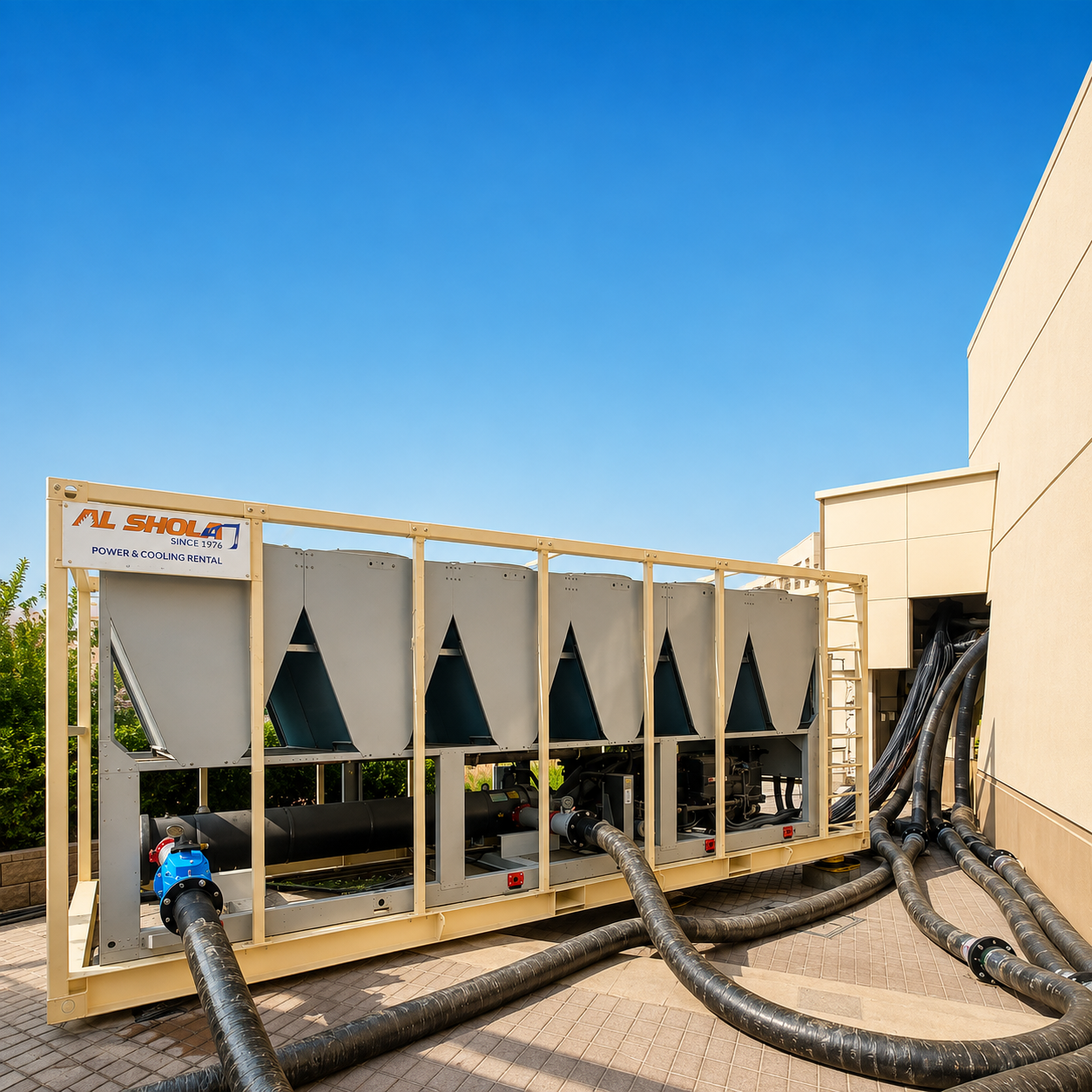
concrete cooling chiller rental uae
Fresh concrete temperature is an important quality-control parameter because it affects workability, setting behaviour, moisture loss, and early-age strength development. When concrete ingredients are already hot before mixing, the finished mixture can become more difficult to transport, place, compact, and finish.
The temperature limit must be confirmed against the applicable authority requirements, approved mix design, and project specifications. This is particularly important for concrete used in foundations, bridges, high-rise buildings, industrial floors, and other structural applications.
Does the UAE Building Code require concrete to remain below 32°C?
A limit of 32°C is specified in some construction projects, but it is important not to present it as a universal UAE building-code requirement.
Dubai Municipality’s DMS 026:2018, Technical Requirements for the Operation of Ready-Mixed Concrete Plants states that the temperature of placed concrete must not exceed 35°C, unless the project specifications impose a stricter limit. The standard identifies several hot-weather control measures, including shaded aggregate stockpiles, flaked ice, chilled mixing water, and control of the time between batching and placement.
Therefore, if a project requires fresh concrete to remain below 32°C, the contractor must meet that stricter project requirement. The applicable authority requirements and the approved specifications should always be checked before determining the chiller’s operating setpoint.
The distinction is important: the required temperature of fresh concrete is not the same as the temperature of the water supplied by the chiller. Mixing water may need to be much colder than the target concrete temperature because the cement, aggregates, and other ingredients also contribute heat.
Why hot-weather concreting needs careful management
The Federal Highway Administration explains that high temperatures and elevated ingredient temperatures can accelerate cement hydration, shorten setting time, and complicate placement and curing. Changes in temperature after placement can also contribute to thermal stresses and cracking.
In the UAE, temperature control is especially relevant to:
-
Large raft foundations and basement slabs.
-
Bridge decks, road infrastructure, and elevated structures.
-
High-rise building foundations, columns, and structural cores.
-
Industrial foundations and heavy-duty concrete floors.
-
Large commercial and residential developments.
-
Ready-mix concrete production during peak summer demand.
The objective is not simply to cool the water. It is to deliver fresh concrete within the required temperature range while maintaining the approved mix proportions, workability, and quality.
How a Batching Plant Water Chiller Works
A batching plant water chiller removes heat from water using a refrigeration system and supplies the cooled water to the plant’s mixing-water storage or metering equipment. The batching system then measures the required quantity of water and adds it to the concrete mix according to the approved mix design.
A typical installation may include an industrial chiller, insulated storage tank, circulation pumps, pipework, temperature sensors, control equipment, and connections to the batching plant.
The equipment must be selected according to the plant’s actual cooling demand. A unit that can achieve the target temperature under light demand may not be sufficient when the plant is producing concrete continuously at peak capacity.
Supplying chilled water at +4°C to +7°C
A chilled-water supply temperature of +4°C to +7°C can be specified as a project operating target when the concrete mix design and site conditions require it. This is not a universal temperature mandated by UAE regulations; the appropriate setpoint must be established by the project and cooling-system design teams.
A typical operating process involves the following stages:
-
Incoming water enters the cooling system.
-
The chiller reduces the water temperature to the required setpoint.
-
An insulated storage tank helps maintain the supply temperature and provides a buffer for changing demand.
-
Pumps deliver chilled water to the batching plant’s mixing-water tank or metering system.
-
The batching equipment measures the water quantity required for each batch.
-
Quality-control personnel verify the fresh concrete temperature at the point specified by the project.
For reliable performance, the system should be designed to maintain the required supply temperature during actual production, rather than only when the plant is idle.
Why chilled water alone may not be enough
Aggregates form a substantial proportion of concrete and can contribute significantly to the temperature of the fresh mix. Hot sand and coarse aggregates may limit the reduction achievable through chilled mixing water alone.
The FHWA identifies aggregate temperature management as an important cooling measure because aggregates generally account for approximately 75–80% of concrete mass. Depending on the project, additional measures may include shading stockpiles, managing aggregate moisture, using ice as part of the mixing water, and reducing unnecessary delays between batching and placement.
All changes must remain consistent with the approved mix design and the engineer’s instructions.
Choosing Concrete Cooling Chiller Rental in the UAE
Renting a chiller can be a practical option for concrete producers that need additional cooling capacity for a specific project, a busy summer period, or a temporary batching plant. It can also help when an existing cooling system is undergoing maintenance or cannot meet the required production demand.
Rental Generator’s rental chiller service describes temporary cooling systems for industrial and construction applications, with equipment configurations that can include pumps, pipework, and other supporting components.
Rental Generator
What should be assessed before renting?
The correct rental system depends on several connected factors.
Cooling capacity and water demand: The supplier needs to know how many litres of water the plant consumes per hour, the incoming water temperature, and the target supply temperature. Peak demand is particularly important when several batches are produced in quick succession.
Storage and distribution: Insulated tanks and properly sized pipework help maintain chilled-water temperatures between the chiller and the batching equipment. Tank capacity should be matched to the production schedule.
Operating conditions: The system must perform under the actual outdoor temperature, site layout, electrical supply, and operating hours. A chiller’s nominal rating alone does not establish its available cooling capacity at the required conditions.
Installation and commissioning: The rental arrangement should identify which party is responsible for equipment delivery, connections, pumps, commissioning, temperature checks, and ongoing maintenance.
Operational support: For projects with continuous concrete production, the contractor should agree on maintenance arrangements, response procedures, and backup options before the first major pour.
Estimating the required chiller capacity
The approximate cooling load for water can be calculated using:
\[ Q=\dot{m}\times C_p\times\Delta T \]
Where \(Q\) is the cooling load in kilowatts, \(\dot m\) is the mass flow rate in kilograms per second, \(C_p\) is the specific heat capacity of water (approximately 4.18 kJ/kg·°C), and \(\Delta T\) is the required temperature reduction.
For example, cooling 10,000 litres of water from 35°C to 6°C over four hours requires approximately 84 kW of average water-side cooling capacity, before accounting for heat gains, peak demand, and equipment performance.
This example illustrates the calculation method; it is not a final equipment recommendation. A rental chiller should be selected using the actual water consumption profile, required operating temperature, manufacturer’s performance data, and suitable engineering allowances.
Industrial Process Cooling Rental Beyond Concrete Batching
Concrete production is one application for temporary cooling, but industrial facilities also need reliable temperature control for manufacturing processes, chemical operations, and planned maintenance shutdowns.
Industrial process cooling rental allows businesses to access temporary cooling equipment without committing to a permanent installation for a short-term requirement. Depending on the process, a suitable rental package can provide additional cooling capacity, replace unavailable equipment, or support a planned plant turnaround.
Plastic injection molding
Injection molding equipment needs to remove heat from molds so components can cool and production cycles remain consistent. Chilled water can serve compatible mold-cooling circuits and heat exchangers. The required water temperature, flow rate, pressure, and cooling capacity depend on the machine and the material being processed.
A rental chiller may help during increased production demand, maintenance of the existing cooling plant, or temporary manufacturing projects.
Chemical processing
Chemical plants may require cooling for reactors, heat exchangers, production equipment, and temperature-sensitive processes. Temporary chillers can provide additional capacity when the equipment and process conditions are compatible.
Before installation, the engineering team should confirm the required operating temperatures, heat load, fluid compatibility, pressure limits, and separation between the chilled-water circuit and the process fluid.
Refinery turnarounds
Planned refinery turnarounds involve maintenance, inspection, repairs, and equipment upgrades. Temporary cooling may be needed for suitable process-support duties while existing equipment is unavailable or operating arrangements change.
Cooling requirements must be assessed for each application, with particular attention to hazardous-area classification, site permits, process isolation, heat-exchanger requirements, and emergency procedures.
These applications require different equipment configurations. A chiller selected for concrete mixing water should not automatically be considered suitable for plastic molding, chemical production, or refinery operations without checking the operating requirements.
For a wider view of the sectors supported by the company, visit industries we serve.
Temporary Cooling During Planned Industrial Turnarounds
A planned turnaround can create a temporary gap in cooling capacity. If existing chillers must be isolated for maintenance or replaced, certain operations may need a temporary cooling arrangement to support the approved work plan.
A rental system can be planned before the shutdown begins. This allows the site team to confirm equipment access, connection points, cooling loads, power requirements, pipework routes, and commissioning procedures in advance.
For a successful installation, the scope should establish:
-
The equipment and processes that require cooling.
-
The expected cooling load and required supply and return temperatures.
-
The connection and isolation arrangements.
-
The equipment’s electrical and utility requirements.
-
The required commissioning tests and performance checks.
-
Site safety procedures, maintenance responsibilities, and contingency plans.
Rental Generator’s published chiller service includes temporary cooling support for planned industrial maintenance and turnaround requirements.
Actual suitability, availability, and performance should be confirmed for the specific project.
How Concrete Cooling Helps Reduce Temperature-Related Defects
Concrete cooling is valuable because temperature affects the material both before and after placement. Lowering the initial temperature can help control hot-weather conditions, but it must be combined with appropriate mix design, delivery planning, and curing.
Thermal cracking and temperature gradients
Cement hydration releases heat. In thick structural sections, the internal concrete can become warmer than the outer surface. When different parts of the structure expand and contract at different rates, thermal stresses may develop.
Reducing the initial concrete temperature can help manage the overall temperature rise. For major pours, engineers may also specify internal temperature monitoring, limits on temperature differentials, and other measures suited to the structure.
Workability and setting time
Hot concrete can lose workability more quickly, reducing the time available for transportation, pumping, placement, and finishing. Chilled mixing water can help lower the initial temperature, but it cannot eliminate every effect of hot weather.
The batching plant should coordinate cooling, admixture use, truck dispatch, and site placement. Any adjustments to the mix must be approved and must maintain the specified water-to-cementitious-material ratio.
Moisture loss and early-age cracking
High temperatures, wind, and low relative humidity can increase surface evaporation and contribute to plastic shrinkage cracking. Chilling the mixing water may reduce the initial concrete temperature, but effective curing and protection from rapid moisture loss remain essential.
The FHWA’s guidance on early-age concrete distress explains how hot-weather conditions can accelerate hydration, complicate curing operations, and contribute to shrinkage-related problems.
A complete cooling strategy should therefore address the concrete temperature at placement and the conditions experienced by the structure during early curing.
Quality Control for Concrete Temperature
For contractors using a concrete cooling chiller rental in the UAE, temperature monitoring should be incorporated into the project’s quality-control procedure.
| Monitoring stage | What to check |
|---|---|
| Water supply | Chilled-water temperature and consistency under demand |
| Batching | Correct water quantity and approved mix proportions |
| Fresh concrete | Temperature against the specified acceptance limit |
| Transport | Delivery time and concrete condition |
| Placement | Temperature at the required inspection point |
| Curing | Moisture protection and temperature management |
| Mass concrete | Internal temperature and gradients where required |
If the fresh concrete exceeds the specified limit, the contractor should follow the approved corrective procedure. Adding unapproved water at the site is not an appropriate substitute for a properly designed cooling system.
Frequently Asked Questions
What is concrete cooling chiller rental in the UAE?
It is the temporary provision of chiller equipment to cool concrete mixing water or support a compatible concrete cooling process. It can help ready-mix plants and construction contractors manage fresh concrete temperature during hot-weather production.
Must fresh concrete always remain below 32°C in the UAE?
Not universally. Dubai Municipality’s DMS 026:2018 specifies a maximum placed-concrete temperature of 35°C, unless a more stringent project specification applies. A 32°C limit should be followed when it is required by the applicable project documents or authority requirements.
Can a batching plant water chiller supply water at +4°C to +7°C?
Yes, if the chiller, storage tank, pumps, and distribution system are designed for the required cooling load and operating conditions. The final setpoint should be confirmed by the project’s technical team.
Does chilled water alone guarantee that concrete remains below 32°C?
No. Aggregate temperature, cement temperature, ambient conditions, transportation time, and the mix design also influence the temperature of fresh concrete. Additional cooling measures may be necessary.
Which industries can benefit from industrial process cooling rental?
Suitable applications include concrete batching, plastic injection molding, chemical processing, and selected refinery-support duties. The equipment must be matched to each application’s cooling load, temperature, fluid, and safety requirements.
Is rental cooling suitable for planned plant maintenance?
Yes. Temporary chillers can provide additional or replacement cooling capacity during maintenance or turnarounds, provided the cooling requirements and site connections are assessed in advance.
Conclusion: Arrange Concrete Cooling Chiller Rental in the UAE
Managing fresh concrete temperature is an important part of hot-weather construction. A correctly sized chiller can supply controlled-temperature water to a batching plant, helping the contractor work toward the required concrete temperature while supporting production continuity.
For projects with a specified 32°C limit, the cooling arrangement should be designed around that requirement rather than assuming a standard water temperature will achieve it. Chiller capacity, aggregate temperatures, batching rates, delivery times, and curing arrangements all matter.
Beyond construction, industrial process cooling rental can support compatible plastic molding, chemical processing, and refinery turnaround applications.
To discuss your project’s cooling requirements, visit Rental Generator’s process chiller rental page and provide the required water temperature, estimated flow rate, cooling load, site location, and rental duration.
Need Reliable Temporary Power or Cooling in the UAE?
From 20 kVA mobile silent generators up to multi-megawatt synchronized power plants and 500 TR packaged chillers. Complete turnkey delivery, cabling, and 24/7 on-site maintenance across Dubai, Abu Dhabi, and Sharjah.