Phone:
(701)814-6992
Physical address:
6296 Donnelly Plaza
Ratkeville, Bahamas.

Phone:
(701)814-6992
Physical address:
6296 Donnelly Plaza
Ratkeville, Bahamas.
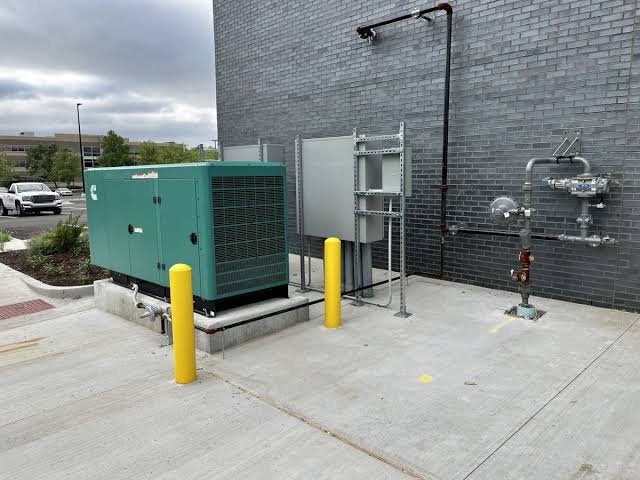
Choosing the right generator for a commercial building in the UAE is not simply a matter of selecting the largest available diesel generator. The required capacity depends on what the generator must operate during a power interruption, the building’s electrical demand, HVAC systems, lifts, pumps, lighting, security equipment, and the starting requirements of motors.
For some commercial buildings, a generator may only need to support essential services. For others, particularly major commercial, tourism, cultural, and similar facilities in Dubai, backup-power requirements can extend to a broad range of essential loads. DEWA guidance for covered commercial projects calls for standby generation of adequate capacity for 100% backup of specified essential services through automatic changeover arrangements.
So, what size generator does a commercial building need in the UAE? The answer starts with a proper load assessment rather than a generic kVA recommendation.
An undersized generator can struggle when large equipment starts, causing voltage or frequency dips, overloads, nuisance shutdowns, or failure to support critical equipment.
An oversized generator is not automatically better. It can increase rental or purchase costs and may operate inefficiently when the actual building load is much lower than its rated capacity. Caterpillar specifically notes that generator sizing should consider both running and starting demand and warns that excessive oversizing can increase costs and contribute to poor operating conditions at very low loads.
The objective is therefore to select a generator that can reliably handle the required load while maintaining appropriate electrical performance.
Commercial generators are commonly specified using both kW and kVA.
A simplified relationship is:
kW = kVA × Power Factor
For example, a generator rated at 500 kVA at a power factor of 0.8 corresponds to approximately 400 kW of real power.
However, buyers should not select a generator by converting their building’s kW demand into kVA alone. The generator’s manufacturer data, power factor, load characteristics, motor starting requirements, voltage, frequency, and application rating all need to be considered.
A small office building and a large shopping facility can have completely different power requirements.
For example, a commercial facility may have:
DEWA’s guidance for covered commercial, tourism and cultural projects identifies essential loads including lifts, elevators, escalators, firefighting and safety equipment, security systems, CCTV, alarms, BMS, emergency areas, control rooms, data centers and electrical rooms.
This is why the building’s load profile must be assessed before selecting a generator.
The first question is not “How many kVA do I need?”
It is:
“What equipment needs to remain operational when utility power is unavailable?”
There are generally two approaches.
The generator supplies only critical equipment.
This could include:
This approach can significantly reduce the required generator capacity compared with powering the entire building.
The generator is designed to support a much larger proportion of the building’s electrical demand.
This approach requires a considerably more detailed load assessment because major HVAC systems, elevators, pumps, refrigeration and other high-demand equipment may operate simultaneously or start in sequence.
The applicable project requirements should always be confirmed with the relevant authority and electrical consultant.
The next step is to identify the electrical demand of the equipment that will operate while the generator is running.
Create a load schedule containing equipment such as:
| Load | Connected Load | Expected Running Load | Starting Requirement |
|---|---|---|---|
| Lighting | — | — | Low |
| Computers/IT | — | — | Low |
| HVAC | — | — | High |
| Pumps | — | — | High |
| Elevators | — | — | High |
| Fire systems | — | — | Motor dependent |
| Security/CCTV | — | — | Low |
| Refrigeration | — | — | High |
The actual values must come from the building’s electrical drawings, equipment nameplates, measured demand, manufacturer information, or an engineering assessment.
DEWA’s electrical installation regulations also require actual loads to be considered for stationary appliances and equipment such as air-conditioning equipment.
A commercial building does not consume exactly the same amount of electricity throughout the day.
An office may have relatively low demand outside working hours but significantly higher demand during business hours. HVAC demand can also change considerably depending on operating conditions.
Therefore, using an average electricity consumption figure alone can result in an inappropriate generator selection.
For an existing building, actual electrical metering data can be extremely useful. Caterpillar recommends reviewing the facility’s load profile and notes that actual metering data is valuable when determining generation capacity.
For a new building, the design load schedule and equipment specifications become particularly important.
One of the biggest mistakes in commercial generator sizing is considering only running power.
Large motors can require significantly more power during startup than during normal operation. Examples include:
Caterpillar explains that generator sizing should account for higher starting or surge demands from equipment such as motors and HVAC systems. Its sizing tools evaluate both running and starting requirements.
If the generator can support the building’s normal running load but cannot start a large motor without excessive voltage or frequency disturbance, the selected generator is not suitable.
Air conditioning can be a major electrical load in UAE commercial buildings.
A facility with several chillers, packaged units, pumps and air-handling systems may require substantially more generation capacity than an office with smaller split or packaged systems.
This is particularly important when the generator is expected to maintain cooling during an outage.
You should determine:
If only selected areas require cooling during an outage, load management may reduce the generator capacity required.
Commercial buildings do not necessarily need every load to start at the same time.
An automatic transfer switch and generator control system can be configured so that loads are introduced in stages where the system design permits it.
For example:
Stage 1: Emergency lighting and critical controls
Stage 2: Security and IT systems
Stage 3: Pumps and selected HVAC
Stage 4: Other approved commercial loads
Caterpillar recommends breaking up load steps where possible rather than applying a large block load simultaneously. Load sequencing can help control voltage and frequency changes during startup.
The exact sequence should be designed by the electrical engineer based on the facility and generator system.
Generator ratings also matter.
A generator can have different ratings for standby, prime, and continuous applications.
A standby generator is generally intended to provide emergency backup power during utility outages. Caterpillar describes standby power as emergency backup capacity and specifies operating limitations associated with this rating.
A prime-rated generator is designed for applications involving variable loads and longer operating periods, subject to the manufacturer’s rating conditions.
The correct rating therefore depends not only on the size of the building but also on how the generator will be used.
This is particularly important when renting a generator for prolonged temporary operation rather than occasional emergency standby.
Commercial generator ranges vary significantly between manufacturers and configurations.
For example, Cummins lists commercial-industrial generator sets ranging from relatively small units to machines delivering hundreds of kilowatts and thousands of kVA. Its published commercial generator range includes units around 40–60 kVA, 100–155 kVA, 175–250 kVA, 500–550 kVA and much larger configurations.
This demonstrates why a fixed statement such as “a commercial building needs a 500 kVA generator” is misleading.
A small office could require far less, while a large commercial building with substantial HVAC, lifts and other equipment could require multiple generators or a much larger system.
The following examples are illustrative only, not engineering recommendations.
A small office with:
might fall into a relatively small generator category, depending on the actual connected and demand loads.
A larger office or commercial facility with:
may require a generator in the hundreds-of-kVA range.
A large facility with:
could require several hundred kVA or more, potentially involving multiple synchronized generator sets.
These examples should not be used as final sizing figures. The actual generator must be selected from a project-specific load calculation.
A single generator is not always the best solution.
Multiple generator sets may be considered when:
Caterpillar notes that facility load profiles and design requirements determine whether a single generator or multiple generators operating in parallel are appropriate.
For critical commercial facilities, the electrical engineer should determine the required redundancy and system architecture.
Buying is not always the most practical option.
Generator rental can be useful when a commercial building needs temporary backup power for:
Rental also allows a business to obtain a generator matched to a specific temporary requirement without permanently purchasing a large machine.
However, the same sizing principles still apply. A rental generator should be selected based on the actual load, starting requirements, voltage, frequency, operating duration, and site conditions.
The generator’s operating environment also matters.
When requesting a generator quotation, provide information such as:
Caterpillar’s commercial sizing tools specifically include environmental conditions such as maximum ambient temperature, altitude and humidity when evaluating generator requirements.
This is important because the generator should be selected for the actual conditions under which it will operate rather than simply relying on a nominal rating.
A simplified preliminary approach is:
Required generator capacity ≈ required running load + starting/load-management considerations + appropriate engineering margin
For kVA:
kVA = kW ÷ Power Factor
But this is only a preliminary calculation.
It does not replace a professional generator sizing study because the final selection must account for motor starting, load steps, harmonics, voltage and frequency performance, environmental derating, generator rating, and the characteristics of the equipment being powered.
Caterpillar specifically recommends validating sizing calculations for critical applications because simplified sizing tools may not capture every site-specific characteristic.
If you are requesting a commercial generator rental quotation in the UAE, prepare as much of the following information as possible:
Providing this information allows the rental provider and electrical engineer to recommend a more appropriate generator configuration.
Avoid these common mistakes:
Two buildings with the same floor area can have completely different electrical demands.
Starting kVA, power factor and motor characteristics can influence the generator selection.
Air conditioning can represent a substantial portion of a commercial building’s electrical demand.
A generator may support the running load but fail to start a large motor correctly.
Oversizing can increase costs and may result in inefficient low-load operation.
A building may need backup for specific safety and operational systems even when full-building backup is unnecessary.
Sizing calculators are useful for preliminary assessment, but complex commercial projects should be validated by qualified electrical professionals.
Before renting or purchasing a generator for a commercial building in the UAE, confirm:
So, what size generator does a commercial building need in the UAE? There is no reliable one-size-fits-all answer.
A small office may need a relatively modest generator, while a large commercial building with central HVAC, elevators, pumps, fire systems and other critical equipment may require several hundred kVA or multiple generator sets.
The correct approach is to start with the building’s actual electrical load, identify the equipment that must remain operational, calculate starting requirements, consider load sequencing and environmental conditions, and then select a generator with the appropriate kW/kVA and operating rating.
For Dubai projects in particular, DEWA requirements should also be reviewed where applicable. DEWA guidance for covered commercial, tourism and cultural premises specifies adequate standby capacity for identified essential services, including safety, security, lift and other critical systems.
For a temporary requirement, generator rental in the UAE can provide a practical way to obtain the required capacity without making a permanent capital investment. Whether buying or renting, however, the generator should be selected from a proper load calculation-not from the building’s square footage or a generic kVA estimate.